
Every time I talk about how I work with AI, someone says the same thing. "You make it sound like a relationship." And then, usually with a raised eyebrow: "Do you actually love it?"
Here is my honest answer: if "love" means I treat it with respect, invest time in it, and think carefully about how I communicate with it, then yes. Kind of.
But this article is not about my feelings for a language model. It is about why most people are getting average results from AI, and what I did differently. I am going to tell you the mistake I made at the start, the technique that changed everything, and one story that I think will stick with you.
When everything changed
July last year, my business partner moved on. And honestly, it felt like a huge loss.
Overnight, I was handling every email, every proposal, every client delivery, and every admin task on my own. Everything landed on one desk. My desk.
I made a decision. I was not going to shrink. I was going to lean into AI.
I had no idea what that would look like. What I did know was that the business I had built was worth fighting for. And I was willing to figure it out.
The business is bigger now than when I was a two-person team. That is not a boast. That is the point of this article.
What it actually looks like on a real Tuesday
When people say "I use AI for my business," it can mean almost anything. So let me be specific. Here is what a real working day looks like:
That last one is the one people underestimate most. When you are solo, or when your team is stretched, the thinking-partner function of a well-trained AI is genuinely valuable.
But here is what I got wrong at the start.
The mistake most people make
I treated AI like a search engine. Type a question. Get an answer. Move on.
The results were fine. Not great. Not the thing I had read about. Not the thing that was apparently saving other business owners hours every week.
Then I changed my approach entirely.
Treat it like a relationship, not a technology
Think about how you manage the people who are important to your business.
You would not run a key relationship purely on two-line emails. When you have more to say, when the context matters, when you want a quality outcome, you pick up the phone.
The same principle applies here. And the technique that changed everything for me was this: voice-to-text.
When I have something complex to work through, I do not type. I talk. I explain the context. I say what I need and why. I tell it what the client is like, what the audience cares about, what I am worried about getting wrong. All of it.
When it matters, I do not type. I talk. Richer input produces richer output, every time.
The quality of what comes back is not even comparable to what I got when I was typing short queries. This is not a technical tip. It is a communication principle. And because I can talk much faster than I can type, it is also significantly quicker.
How deep the relationship goes
A friend sent me a blog post with a prompt: get your AI to ask you 100 questions to really understand you and your business.
I put it to mine and asked: is this worth us doing?
It came back and said, honestly, I already know about 80% of these answers from our work together. Here they are. But the other 20% are genuinely worth exploring, and I want to ask you those questions.
That response told me two things. First, the depth of what I had built by consistently showing up and communicating well. Second, that AI is smart enough to tell you what it needs rather than just going through the motions.
I am not a tech expert. I have not taken courses in prompt engineering. I just kept showing up and kept communicating. That is available to you too.
What goes in, and what stays out
This is the question I get asked most in workshops. What can you actually put into AI? Here it is in plain language. Green is go. Amber means think first. Red is the line you do not cross.
Shadow AI: your staff are already doing it
If you have a team, here is something worth knowing. Your staff are probably already using personal AI tools at work without you knowing. This is called Shadow AI, and it is more common than most employers realise.
The instinct is to lock it down. The smarter move is to bring it into the open.
Have the conversation. Find out what your team is already doing. Share what works. Then agree together on what stays out. A simple internal AI policy does not need to be a legal document. It just needs to answer three questions: what do we use it for, what data never goes in, and who checks the output before it leaves the business.
The businesses that handle this well are not the ones that banned AI. They are the ones that got ahead of it.
The Australian Privacy Act, in plain terms
If you are running a business in Australia, there is a specific legal framework that applies here. The Privacy Act 1988 covers organisations with an annual turnover above $3 million, and all health service providers regardless of size. If that is your business, you have formal obligations under the Australian Privacy Principles, overseen by the Office of the Australian Information Commissioner (OAIC). Those obligations include how you collect, store, use, and disclose personal information, and AI tools are not exempt from them.
If your turnover is below the threshold, you are technically exempt from the Act. But exempt does not mean no obligation. Your clients, your contracts, and your professional reputation all set a standard that exists whether the law requires it or not.
One more thing for anyone working with government clients. Councils and agencies often have data sovereignty requirements, meaning they want their data stored in Australia. If a client ever asks you about this, the answer they want to hear is: "I know where your data is, I know what goes where, and I have a policy." That is not complicated to have. It is just something most small businesses have not thought about yet.
The law tells you what you must protect. Your client relationship tells you everything else.
Where I am honestly right now
Here is the honest picture, because I am tired of AI articles that claim everything is running on autopilot and everyone saved thirty hours a week.
I am in what I call construction mode. I have been building the systems while still delivering for clients, which means I do it in the time around my actual work. I cannot give up the business to build the AI layer inside it. I have to do both at once.
The frameworks are in place. The tools are connected. The automated workflows are coming. The time savings are not fully here yet. But the business is already bigger than it was when I was a team of two. And I can see exactly what is ahead when the systems click into place.
This is a better story than a made-up number. It is the real one.
What eMotion Video does now
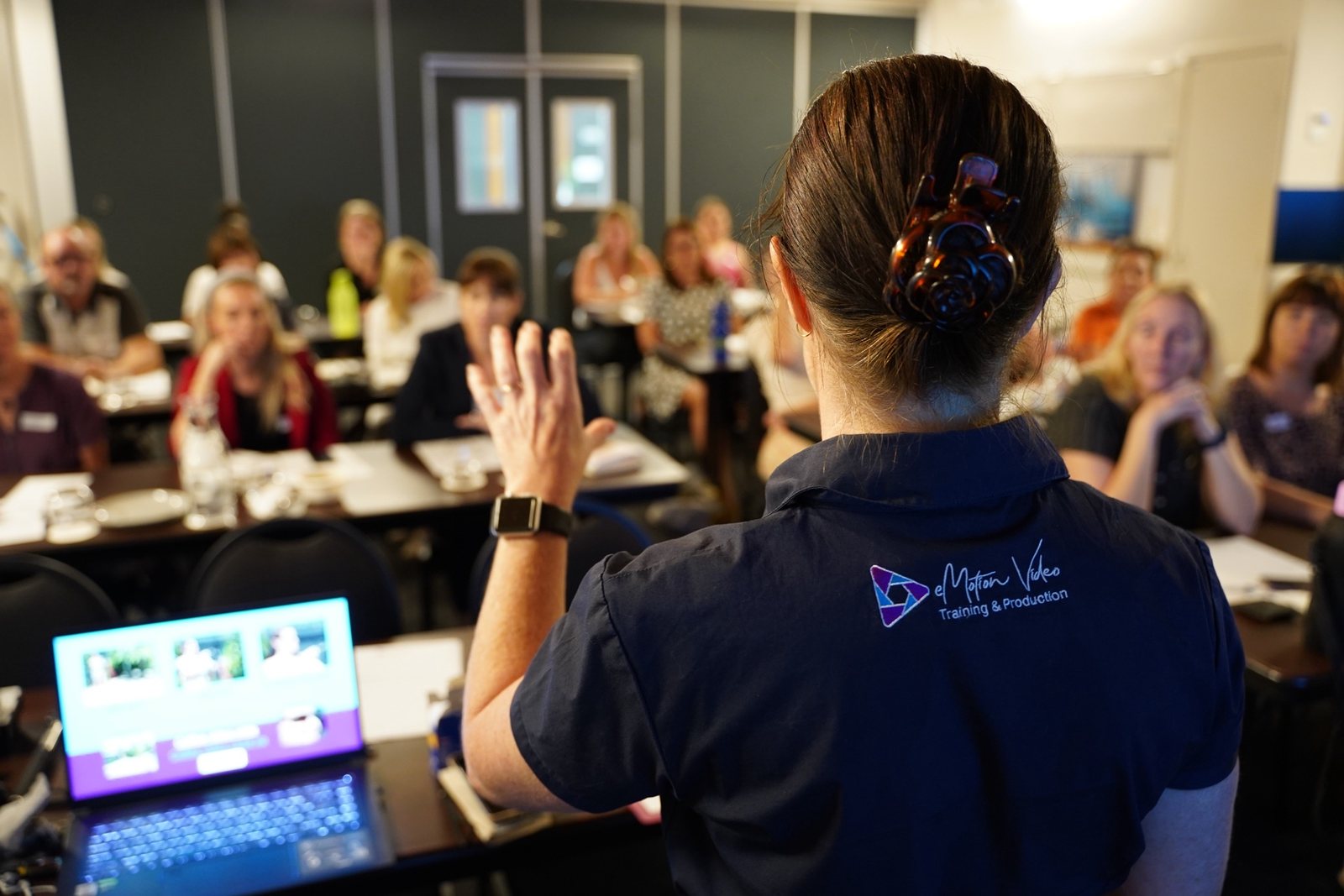
This year I expanded what we offer. We train teams on-site in video, digital skills, and AI, using the devices they already have. We come to you. We work with your people, your content needs, your goals.
We work with small businesses, councils, government agencies, NFPs, and Indigenous organisations across Queensland. Individuals or whole teams. Every package is built around what you actually need.
I added AI training to what we do because I found it genuinely easy to get real results with. That is the version I teach. Not theory. What I have actually lived.
Three things to do this week
- Pick one task you genuinely dislike. Use AI for only that. Give it four weeks.
- When you have more to say than a short question, switch to voice-to-text. Have a conversation, not a query.
- Stay curious. Ask your AI: what am I missing? What have we not thought of yet?
Want a hand getting started?
Whether you want to bring AI into your business or just work out a safe first step for your team, we can help you find it. No pressure, just a friendly chat, the way I would explain it over a coffee.
Have a chat